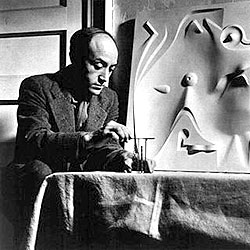
Isamu Noguchi (1904-1988) American-Japanese designer, architect, and artist Isamu Noguchi inimitably blended American modernism with traditional Japanese arts and crafts in both his interior and landscape architecture and sets, as well as in his autonomous sculptures. He saw himself as an artistic link between East and West and throughout his long career balanced the intersection of art and design; the figurative and the abstract; the organic and the geometric. His definition of sculpture was very broad, and he created not only sculptures but also theatrical sets, lamps, furniture, and designs for public spaces. He bridged the gap between the visual and applied arts. From light sculptures to landscapes, from 1932 onward, Noguchi developed abstract furniture for prestigious manufacturers such as Knoll Associates and Herman Miller, who produced the 1944 “Coffee Table” for decades. Of all his industrial designs, he became known to the general public worldwide for his paper light sculptures “Akari,” which he developed in the 1950s and 1960s for the Japanese city of Gifu. As a landscape architect, Noguchi designed numerous public spaces, such as playgrounds, parks, and gardens. In the 1950s, he created the gardens for Keio University in Tokyo, the Lever House in New York, and the UNESCO headquarters in Paris. His two most important projects from the 1960s were the sculpture garden of the National Museum in Jerusalem and the gardens surrounding the Connecticut General Life Insurance building. Isamu Noguci’s oeuvre reflects his fascination with the limitations and possibilities of structures within the natural landscape. Noguchi builds installations and models in various settings; autonomous sculptures in sand; light sculptures in a domestic setting; granite and marble sculptures in a Japanese garden; decorative elements in a theatrical setting; and interior designs in an open space.
BeBoB was founded with a focus on recycling and started as a foundation, not profit-based.
For almost 40 years, it has specialised in collecting and selling midcentury design, focussing on the right matches more than how to get the best profit.
BeBoB charges reasonable prices for vintage and collector’s items.
Vintage Prices are approximately 35% to 65% of the new-to-order price, if items are still new in production. If not anymore in production they become collectibles.
Collectibles are also the original pieces from the design period of the items, which are still in production and are more expensive, but often a good investment out of scarcity.
BeBoB charges reasonable prices for vintage and collector’s items.