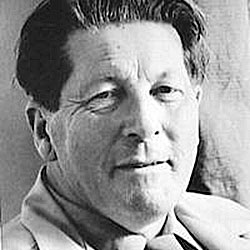
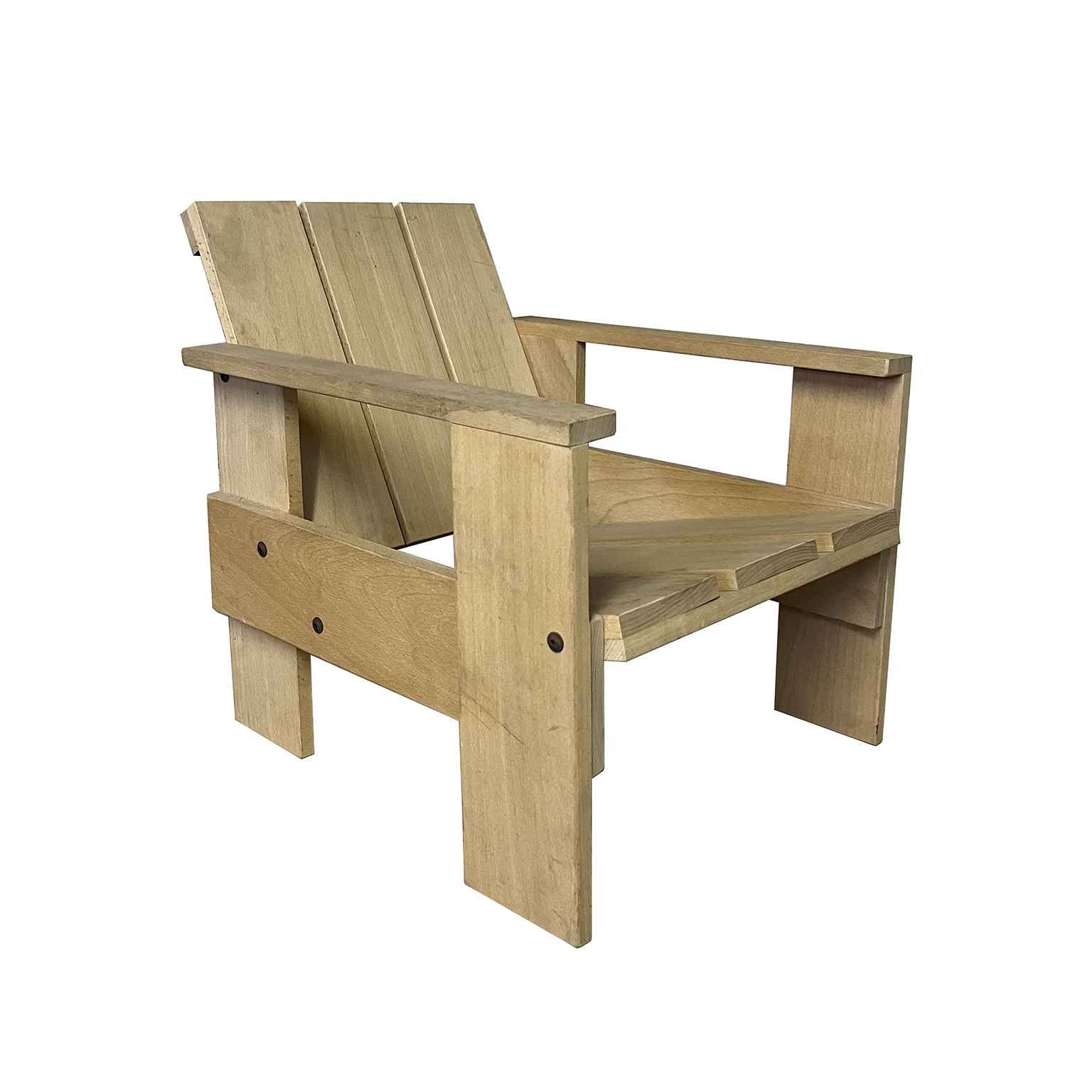
Rietveld, Gerrit Thomas (Utrecht, June 24, 1888 – ibid., June 25, 1964), Dutch architect and furniture designer, learned his craft as a cabinetmaker in his father’s workshop (1899-1906). Between 1906 and 1911, he took courses in architectural drawing, including with P. Houtzagers in Utrecht. In 1911, he opened his own furniture workshop, while taking evening architecture courses with P.J.C. Klaarhamer (1911-1915). During these years, he became acquainted with Van ‘t Hoff, Van der Leck, Van Doesburg, and other later members of De Stijl, which group he joined in 1919; His furniture designs from these years, in the characteristic primary colors (red, yellow, blue), are pure realizations of De Stijl’s ideas. Established as an independent architect in Utrecht in 1919, he began collaborating with the interior designer Truus Schröder-Schräder in 1921. The Schröder House in Utrecht (1924), an internationally groundbreaking design, in which he incorporated both De Stijl’s ideas regarding function, construction, form, and space, as well as those of functionalism, the logical continuation of De Stijl. From 1923 onward, Rietveld occasionally collaborated with Theo van Doesburg and Cornelis van Eesteren. In 1928, he was one of the founders of CIAM. When De Stijl was dissolved in 1931, a difficult period also began for Rietveld. His designs for workers’ housing were never implemented; Modern architecture was threatened with being overshadowed by a traditionalist “national style,” and it wasn’t until 1955 that Rietveld regained the reputation he deserved. His Work: Rietveld is often seen as a “spontaneous genius” who could one day create a red-and-blue chair and a Rietveld-Schröder House. This underestimates his thinking and abilities. Anyone who surveys his entire oeuvre must conclude that all his creations grew organically. One of his colleagues who certainly did him justice was Aldo van Eyck, who wrote in an article: “I admire Rietveld for his artistry, for the magnificent things he created during the De Stijl period. For the way in which he single-handedly forged a new architectural language, which was able to evolve into what Mondrian and Van Doesburg envisioned: a liberating human habitat, an environment shaped in such a way that at least nothing frustrating would arise from it.” Rietveld, from his lecture at the Centraal Museum in Utrecht: “In order to become completely free of tradition for a while, as a transition and as a study, fresh and pure enough to be the background and breeding ground for the new life, many ideals had to be sung about and then wholeheartedly unlearned. De Stijl and the Bauhaus contributed a great deal to this. De Stijl embarked on an almost scientific search for the elements of vision. We tried to find the very simplest things, the indivisible visual impressions,We analyzed white light into three colors, to which our eye is sensitive, and we found that the impression of red was an indivisible impression and therefore a purely primary and elementary feeling. We worked with those feelings.” His Vision: “Works of art from the past share one characteristic that makes them directly appealing: clarity. Distance and differences in attitudes to life cannot obscure this. Contemporary art, criticisms, and attempts at explanations are usually unclear. Differences in attitudes to life and status force themselves to the fore. How is it that, despite the best intentions, so much disagreement persists regarding the appreciation and understanding of contemporary art? Because people speak poorly about art; it becomes a matter of feeling. Contemporary art is repulsive because it attempts to awaken, and because no associations are felt with familiar feelings.” What drives a man to take up arms against the established order in his birthplace of Utrecht? Why does he start experimenting with new models and new colors in his carpentry workshop?
BeBoB was founded with a focus on recycling and started as a foundation, not profit-based.
For almost 40 years, it has specialised in collecting and selling midcentury design, focussing on the right matches more than how to get the best profit.
BeBoB charges reasonable prices for vintage and collector’s items.
Vintage Prices are approximately 35% to 65% of the new-to-order price, if items are still new in production. If not anymore in production they become collectibles.
Collectibles are also the original pieces from the design period of the items, which are still in production and are more expensive, but often a good investment out of scarcity.
BeBoB charges reasonable prices for vintage and collector’s items.